
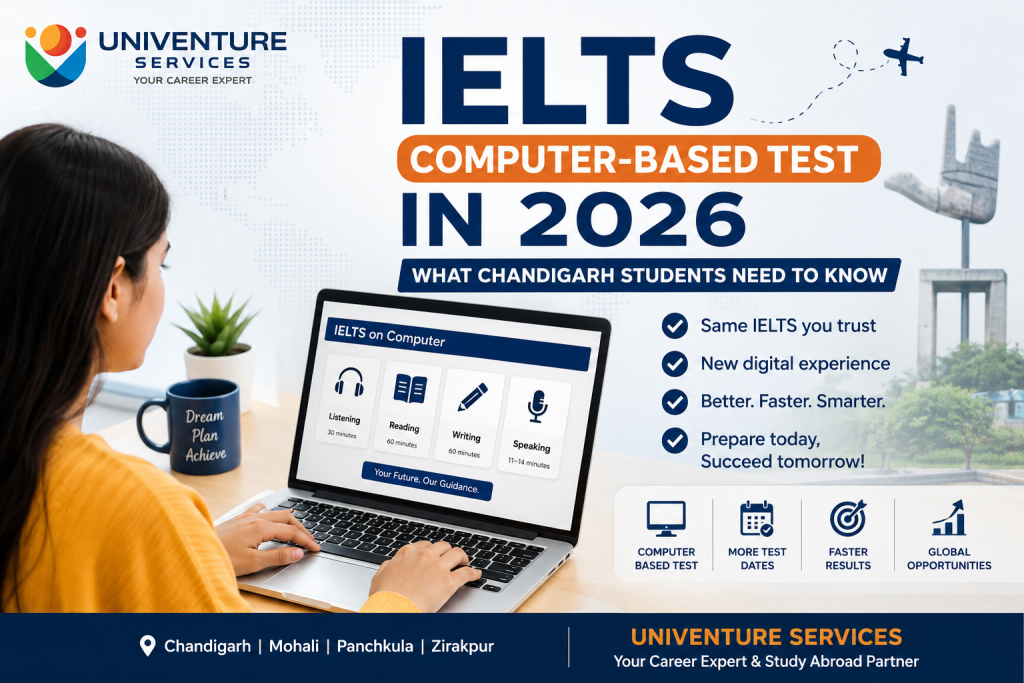
Planning to study abroad in 2026? If IELTS is part of your study-abroad plan, there is an important change you should know about.
IELTS is moving towards computer-delivered testing, and from mid-2026, IELTS has announced that paper-based delivery will no longer be offered globally. However, the exact transition timeline can vary by country and market. The important point for students is that the IELTS test itself is not becoming a different English test. The skills assessed, scoring approach and overall test structure remain essentially the same; what changes is how you enter your answers.
For students in Chandigarh, Panchkula, Mohali and the wider Tricity, this means now is the right time to understand the IELTS computer-based format and start preparing accordingly.
If you’re searching for IELTS coaching in Chandigarh, IELTS preparation near me, or guidance for your study-abroad journey, this guide will help you understand what to expect.
What Is the IELTS Computer-Based Test?
IELTS on computer is the same IELTS examination delivered through a computer instead of writing answers on a traditional answer sheet.
The test continues to assess four important English-language skills:
- Listening
- Reading
- Writing
- Speaking
For IELTS on computer, Listening, Reading and Writing are completed on a computer, while the Speaking test continues to be conducted as a face-to-face interaction with a certified examiner.
So, if you have been worried that computer-based IELTS means a completely new examination, don’t panic.
The test isn’t changing its purpose — your preparation simply needs to match the digital format.
Why Is IELTS Moving Towards Computer-Based Testing?
The move towards computer-based testing reflects the increasing use of digital examination systems worldwide.
For students, computer-based IELTS can offer several practical advantages, including:
1. Better Digital Familiarity
Students today already spend a significant amount of time using computers, laptops and smartphones. Practising IELTS on a computer can therefore make the actual examination environment more familiar.
2. Easier Editing
When writing an essay on a computer, you can generally edit, delete and reorganise text more easily than when writing everything by hand.
This can be particularly useful in the IELTS Writing test, where planning, organising and correcting your answers are important.
3. Better Legibility
Your answers are typed rather than handwritten, which eliminates concerns about handwriting being difficult to read.
4. More Practice Opportunities
Students can regularly practise using computer-based mock tests and become comfortable with the digital interface before their actual IELTS exam.
Is Computer-Based IELTS Easier Than Paper-Based IELTS?
This is one of the most common questions students ask.
No — computer-based IELTS is not designed to be easier or harder than paper-based IELTS.
The test assesses the same English-language abilities, and the official IELTS information states that the questioning pattern, format, level of difficulty and scoring remain the same.
The difference is primarily how you interact with the test.
Think of it this way:
Paper IELTS → Write your answers
Computer IELTS → Type your answers
Your English ability is still what matters.
IELTS Computer-Based Test in Chandigarh
For Chandigarh students, computer-based IELTS is already an established option.
Official IELTS listings currently show computer-based IELTS availability at IDP test centres in Chandigarh, including Sector 17 and Sector 34 locations.
This makes Chandigarh a convenient location for students from the wider Tricity region, including:
Chandigarh | Mohali | Panchkula | Zirakpur | Kharar | Derabassi
Students should always check the official IELTS booking system for the latest test dates, availability and applicable fees before booking.
What Is the IELTS Exam Pattern in 2026?
The four sections remain:
IELTS Listening
You listen to recordings and answer questions based on the information provided.
Preparation tip: Practise listening to different accents and learn to identify keywords quickly.
IELTS Reading
You read passages and answer different types of questions.
Preparation tip: Work on scanning, skimming, vocabulary and time management.
IELTS Writing
You complete writing tasks that assess your ability to communicate ideas clearly and effectively.
Preparation tip: Don’t simply memorise essays. Learn how to structure your answer, develop ideas and use appropriate vocabulary and grammar.
IELTS Speaking
The Speaking test remains a face-to-face conversation with a trained examiner.
Preparation tip: Practise speaking naturally rather than trying to memorise complicated answers.
What Should Chandigarh Students Do Differently for Computer IELTS?
The biggest change isn’t necessarily your English preparation — it’s your test-taking practice.
If you’re preparing for IELTS in 2026, include computer-based mock tests in your routine.
Practise Typing
If you normally write everything by hand, spend time typing English paragraphs and essays.
You don’t necessarily need extremely fast typing.
What you need is accurate and comfortable typing under time pressure.
Practise Reading on Screen
Reading long passages on a screen can feel different from reading printed pages.
Start practising regularly so that screen reading doesn’t become a problem on test day.
Practise Digital Navigation
Become comfortable with:
- Selecting answers
- Moving between questions
- Highlighting information
- Taking notes
- Reviewing answers
- Managing your time
Official IELTS preparation resources also provide familiarisation material for students preparing for IELTS on computer.
Is IELTS Computer-Based Better for Students?
That depends on the individual.
Computer-based IELTS may be particularly comfortable for students who:
- Prefer typing over handwriting
- Regularly use computers
- Like editing written answers
- Are comfortable reading from screens
- Want to practise through digital mock tests
However, students who are unfamiliar with typing or digital testing should not wait until the final week to practise.
The solution is simple: start early.
How IELTS Coaching Can Help You Prepare
Preparing for IELTS isn’t simply about learning English.
You also need to understand:
- Test structure
- Question types
- Time management
- Writing structure
- Speaking strategies
- Reading techniques
- Listening techniques
- Common mistakes
- Mock-test analysis
This is where professional preparation can make the process more organised.
For students searching for IELTS coaching Chandigarh, the right coaching environment should focus not only on completing a syllabus but also on practice, feedback and individual improvement.
IELTS Preparation in Chandigarh, Panchkula & Mohali
For students from the Tricity, location is often an important consideration.
Instead of searching only for “IELTS coaching near me,” students should compare coaching options based on:
Faculty + Practice + Feedback + Mock Tests + Individual Attention + Study-Abroad Guidance
A good preparation plan should identify where you currently stand and what you need to improve.
For example:
A student may have strong Reading skills but struggle with Speaking.
Another student may communicate well but lose marks in Writing because of poor structure.
Therefore, one preparation strategy doesn’t work equally well for everyone.
Univenture Services: IELTS Coaching & Study Abroad Guidance
For students planning to study abroad, IELTS is often only one part of the overall journey.
Univenture Services provides study-abroad guidance along with support for English-language test preparation. The organisation states that it provides guidance and resources for IELTS, TOEFL, PTE and other standardised tests, along with career counselling, university shortlisting and study-visa assistance.
This can be especially useful for students in Chandigarh, Panchkula, Mohali and nearby Tricity areas who want to connect their English-test preparation with their larger international education plan.
Instead of thinking only:
“I need to clear IELTS.”
Think:
“I need the right score for the right course, university and country.”
That shift can make your preparation much more meaningful.
How to Choose the Right IELTS Coaching in Chandigarh
Before joining an IELTS coaching centre, ask yourself:
Does the institute provide regular mock tests?
Mock tests help you understand your actual progress.
Do trainers provide individual feedback?
Feedback is particularly important for Speaking and Writing.
Do they prepare students for IELTS on computer?
In 2026, this is becoming increasingly important.
Are classes focused on practical improvement?
You should learn how to solve questions, not simply memorise answers.
Does the organisation understand study-abroad requirements?
If you’re planning international education, broader guidance can help you connect your IELTS score with your university and visa plans.
Don’t Wait Until the Exam Date to Practise on a Computer
One of the biggest mistakes students can make is preparing using only traditional books and then sitting for a computer-based exam without enough digital practice.
Your preparation should gradually become similar to your actual examination environment.
Learn → Practise → Take Mock Tests → Analyse Mistakes → Improve → Repeat.
That’s how confidence is built.
Final Thoughts
The IELTS computer-based test is an important development for students planning to take IELTS in 2026.
But there’s no need to panic.
The core IELTS skills remain the same. The biggest adjustment is becoming comfortable with computer-based Listening, Reading and Writing, while Speaking continues as a face-to-face assessment.
For students searching for IELTS coaching in Chandigarh, IELTS preparation near me, IELTS coaching in Panchkula, or IELTS coaching in Mohali, 2026 is a good time to start preparing with the computer-based format in mind.
And remember:
Your IELTS journey isn’t just about getting a band score. It’s about getting the score that helps you move closer to your study-abroad goal.
With the right preparation, consistent practice and proper guidance, you can approach the IELTS exam with greater confidence.
Planning to study abroad from Chandigarh, Panchkula or Mohali? Start your IELTS preparation with a clear plan and the right guidance. Univenture Services can help you prepare for your English proficiency test and guide you through the wider study-abroad journey.
FAQ Section
1. Is IELTS computer-based mandatory in 2026?
IELTS has announced that from mid-2026 it will no longer offer paper-based IELTS globally, although exact transition timelines vary by market. Students should check the latest availability in their location before booking.
2. Is computer-based IELTS harder than paper-based IELTS?
No. The test content, skills assessed, difficulty and scoring remain the same. The primary difference is the method of answering.
3. Is IELTS computer-based available in Chandigarh?
Yes. Official IELTS listings currently show computer-based IELTS at Chandigarh test centres, including Sector 17 and Sector 34.
4. Does the IELTS Speaking test happen on a computer?
The Speaking test continues to be conducted as a face-to-face interaction with a certified IELTS examiner.
5. Where can I find IELTS coaching in Chandigarh?
Students can compare IELTS coaching institutes in Chandigarh based on trainer experience, mock tests, individual feedback, computer-based practice and overall study-abroad guidance.
6. Can I prepare for IELTS on my own?
Yes. Students can use official preparation resources and practise independently. However, professional coaching can provide structured preparation, feedback and mock-test analysis.
7. Should I practise typing before taking computer-based IELTS?
Yes. Comfortable and accurate typing can make the Reading and Writing experience easier, particularly when working under time pressure.
8. Which is better for IELTS preparation: Chandigarh, Panchkula or Mohali?
There is no universal answer. Students should choose based on coaching quality, accessibility, faculty, practice facilities, feedback and individual support rather than location alone.
9. Does Univenture Services provide IELTS preparation support?
Yes. Univenture Services states that it provides guidance and resources for IELTS, TOEFL, PTE and other standardised tests as part of its study-abroad support.
10. When should I start IELTS preparation for studying abroad?
Ideally, start several months before your intended application deadline. This gives you time to build your English skills, take mock tests, identify weaknesses and retake the test if necessary. Always work backwards from your university application and visa timeline.